
Reviewed · TICKETS
Beijing:Drum and Bell Towers Entry Ticket- Cultural Treasure
Timekeeping lives in two towers. The Drum and Bell Towers stand at the northern end of Beijing’s central axis, and in about two hours you can see how the city marked dusk and morning across the Yuan, Ming, and Qing dynasties. I love the architectural pairing, especially how the Bell Tower sits slightly north of the Drum Tower.
I also like the way the visit is set up for speed. You get an e-ticket in advance and an English textual and visual guide, so you spend less time guessing and more time reading what you are looking at.
The one real catch is practical, there are a lot of steep, long stairs, and the ticket can feel pricey if you are the type who enjoys buying on the spot.
In This Review
- Key things to know before you go
- Drum and Bell Towers: what you’re actually seeing
- The 2-hour flow that keeps the visit enjoyable
- E-tickets and direct entry, the practical way to skip the line
- Inside the Drum Tower: dusk-drums and the “25” detail
- Climbing to the Bell Tower: the 63-ton King of Ancient Bells story
- The architectural complex: Yuan to Qing, plus city-planning logic
- The included English guide: how to use it without a live host
- Price and value: is $13 worth it for two towers?
- Stairs, timing, and who this visit suits best
- What to do after: hutongs and nearby food ideas
- Should you book this Drum and Bell Towers ticket?
- FAQ
- What do I need to bring to enter the Bell and Drum Towers?
- Will I receive a paper ticket or an e-ticket?
- How far in advance are tickets reserved for my visit?
- Can I enter the Bell Tower and Drum Tower directly with the e-tickets?
- What’s included with the ticket?
- Is there a live tour guide or an audio guide included?
- How long should I plan for my visit?
- Is free cancellation available?
- Can I book now and pay later?
Key things to know before you go

- E-tickets for direct entry: you can enter both towers with the e-tickets you receive.
- A timekeeping story you can follow: the complex links to the idea of a dusk drum and a morning bell, with roots reaching back to the Yuan era.
- Big numbers that make the visit memorable: the Yongle-era bell is famous as a 63-ton bell, often called the King of Ancient Bells.
- The guide does more than explain: you get an English PDF-style guide, and it can point you toward nearby hutongs and local food ideas.
- Two buildings, different vibes: the Drum Tower connects to the drum tradition, while the Bell Tower anchors the whole sound-and-time concept.
Drum and Bell Towers: what you’re actually seeing

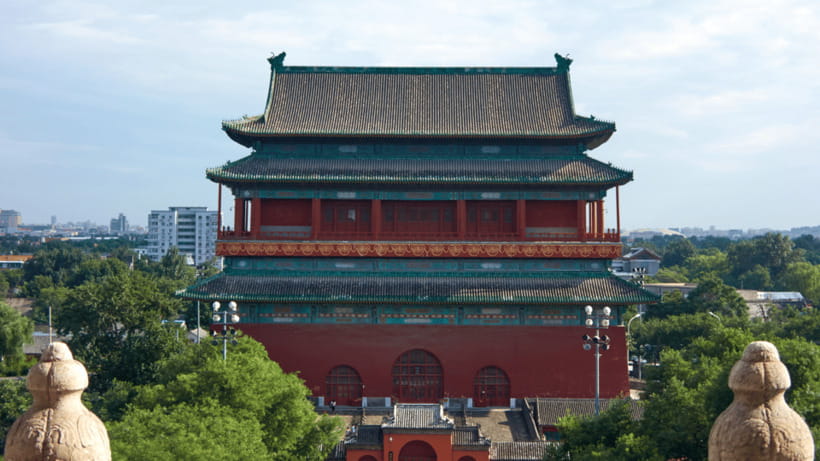
Beijing’s Drum and Bell Towers are not random scenic stops. They are a working-sized slice of how old China organized city life, with timekeeping at the center of public routines. When the system was running, the Drum Tower and Bell Tower acted like the city’s clock, linked to daily rhythms.
The buildings date back to foundations laid in the Yuan Dynasty, which ran from 1206 to 1368. Later, the complex stayed important through the Ming (1368 to 1644) and Qing (1644 to 1911) periods, so the site feels layered rather than purely decorative. Even if you only spend two hours here, you get the sense you are walking through a long-running civic tradition.
Architecturally, the layout is part of the lesson. These towers are on the northern end of Beijing’s main north-south axis, and the Bell Tower sits a touch north of the Drum Tower. That placement matters because it ties the towers to the city’s original planning logic, not just to the neighborhood around them.
And if you like big, specific facts, this place delivers. The Drum Tower is tied to the idea that there used to be 25 drums there. On the Bell Tower side, the Yongle-era bell is the showstopper story, weighing 63 tons and known as the King of Ancient Bells of China.
A few more Beijing days worth comparing
- From Beijing: Mutianyu Great Wall Tours with Options
★ 4.9 · 9,216 reviews - Beijing: Forbidden City Tour(Group/Private)-Tickets Included
★ 4.8 · 7,974 reviews - Beijing: T-Square & Forbidden City Group or Private Tour
★ 4.8 · 4,446 reviews
The 2-hour flow that keeps the visit enjoyable
This is a short visit by design, about two hours, and it works best if you treat it as a walk with reading stops. There is no live tour included, so you will get more out of the experience if you plan to slow down for the guide.
Here is a simple rhythm I recommend:
- Enter, then take 5 to 10 minutes to orient yourself and look for key viewpoints.
- Spend the next stretch reading the English textual and visual guide so you know what you are looking at.
- When you switch from one tower to the other, use the guide again to connect the drum concept to the bell concept.
Because there is no audio guide included, your success depends on you making use of the provided materials. The good news is the guide is designed for self-paced exploring, with both text and visuals, so you are not stuck doing guesswork.
Also note the tone of the experience: it is not a hands-on museum with programs. It is a heritage site where the meaning comes from context, layout, and the stories tied to the towers.
E-tickets and direct entry, the practical way to skip the line

If you hate standing in ticket queues while your day slips away, this is the core advantage. Your e-tickets are reserved for you in advance, and once the reservation is successful, you receive the tickets by email or WhatsApp.
To make the reservation, you provide passport name, passport number, and date of birth. Tickets are reserved three days before your visit, so it is worth ordering soon enough that your details can be processed comfortably.
On arrival, you can enter the Bell Tower and Drum Tower directly using the e-tickets you were sent. That skip matters most in busy periods, when lines can eat up your limited time.
One more practical note: bring your passport or ID card. The site can require it, and it is listed as part of what to bring.
Inside the Drum Tower: dusk-drums and the “25” detail
The Drum Tower experience is where the timekeeping concept becomes concrete. Even without a live guide, you can connect the physical space to what the tradition means: a city marked time with drum signals at dusk.
The key fact to carry with you is the historical reference that there used to be 25 drums in the Drum Tower. That number helps you picture this as a serious system, not just one symbolic drum. When you are looking around, use the guide to connect the layout to the idea of multiple drums and organized signals.
Because this is a heritage complex, you will likely spend your time doing three things: reading, looking closely at structures, and noticing where viewpoints place you in relation to the overall complex. The guide is meant to support that kind of self-guided attention.
If you like learning through specifics, here is what to watch for:
- Any visual explanations that map the tower’s role in the timekeeping system.
- Explanations of how the Drum Tower and Bell Tower work as a pair.
- Anything in the guide that shows the transition from dusk to morning signals.
Also, plan for vertical movement. Multiple reviews highlight that the stairs here are steep and long. It is doable, but it is not the kind of site where you can casually drift up and down. Go slow and take breaks when needed.
Same city, a very different kind of day:
- Beijing: Mutianyu Great Wall Daily Tour with Ticket & Lunch
★ 5.0 · 3,056 reviews - All-Inclusive Tour: Tiananmen Square, Forbidden City, Great Wall
★ 5.0 · 2,873 reviews - MuBus: Mutianyu Great Wall ENG/ESP/RUS Guided Bus Tour
★ 5.0 · 2,361 reviews - 4-Hour Small Group Tour to Forbidden City with Entry Tickets
★ 5.0 · 1,863 reviews
Climbing to the Bell Tower: the 63-ton King of Ancient Bells story

The Bell Tower is the part of the visit that tends to stick in your memory, mostly because of the famous bell story. The bell associated with the Yongle era, from 1403 to 1424, is known to weigh 63 tons. It has earned the nickname King of Ancient Bells of China.
That kind of detail changes how you look at the space. Instead of treating the Bell Tower as another historic building, you start thinking about the scale of sound and civic importance. A bell that heavy is not a background decoration, it is a city tool.
When you are up there, use the English textual and visual guide to connect the bell reference to the tower’s purpose. Even if you have only a couple of hours total, this is the moment when the guide can turn your visit from pretty photos into real understanding.
And yes, you are climbing again. Reviews specifically mention the stairs, so if you know stairs are hard for you, be realistic. The site is not described as tailored for reduced mobility, and the stair challenge comes up more than once.
The architectural complex: Yuan to Qing, plus city-planning logic
One reason this pair of towers feels important is that it is not just one dynasty’s monument. The origin is linked to the Yuan Dynasty, and the complex continued through the Ming and Qing eras. That continuity helps you see the towers as part of long-term city governance, not a one-off build.
The site is also officially protected. The Bell and Drum Towers architectural complex is listed as a historic site under state-level protection, covering an area of 12,597 square meters. That coverage number is a reminder that you are not only visiting two standalone structures. You are in a protected heritage area with a defined layout.
From a traveler’s perspective, that means two things:
- You get a better sense of the site as a system, not isolated buildings.
- You are more likely to find interpretive materials in strategic places, since the complex is meant to be understood and preserved.
The north-axis placement also gives you a mental anchor. If you like walking through cities in an orderly way, this helps you orient yourself. You can picture the old planning idea of a strong north-south axis, then place the towers at the northern end of it.
The included English guide: how to use it without a live host

This activity includes an English textual and visual guide for the Bell and Drum Towers. There is no live guide and no audio guide, so the guide is the main companion you have here.
I like this setup because it gives you control. You can pause when something catches your eye, then move on before your legs or your patience time out. But it only works if you actually open the guide and use it.
Here are two ways I found the guide-style content most useful:
- Use it before you head into each tower, so you know what story thread to look for.
- Re-check the guide at the moment you reach key viewpoints, so the text and visuals lock in your understanding.
One detail that makes this more than a generic explanation: the English PDF-style brochure can also point you toward nearby hutongs and even suggest local restaurants close by. That is valuable because many people treat the towers as a standalone photo stop, then forget the neighborhood connection. If the guide gives you hutong hints, you can turn your visit into a fuller half-day.
Price and value: is $13 worth it for two towers?

At $13 per person for two tower tickets plus an English guide, the value depends on your travel style. The price is not the cheapest way to see the towers, and one comment I saw made it clear that it can feel excessive compared to what people might pay on the spot.
So how do you decide? Here is the practical way I would think about it:
- If you want to minimize time lost to ticket lines, pre-booking is the real payoff. You get e-tickets for direct entry and a skip-the-ticket-line advantage.
- If you are traveling at a quiet time, and you enjoy spontaneous logistics, you might feel more comfortable comparing prices and buying locally.
Where the math can tip toward value is exactly when lines are worst, during peak demand. The experience is built for those days, and the pre-reservation approach helps you lock in access and reduce friction.
My advice: if your day is packed and you do not want to gamble on queues, the $13 feels like you are paying for certainty plus the included guide. If you have extra time and low stress, you might decide to shop around.
Either way, remember you are also paying for access to both the Bell Tower and the Drum Tower within a tight two-hour window, not just one quick photo stop.
Stairs, timing, and who this visit suits best
This site is historic, and historic usually means stairs. Multiple notes call out that the steps are steep and long, and that it may not be ideal if you have mobility limitations. If you are unsure, plan to pace yourself and consider whether two separate climbs are realistic for you.
If you do fine with stairs, this is a strong choice for:
- First-time Beijing visitors who want a meaningful cultural stop without committing to a full guided day.
- Travelers who like self-paced learning and can use a guide to connect facts to visuals.
- People who want a heritage site tied directly to the city’s old rhythm, not just a temple-or-palace checklist item.
If you hate reading on the go and want a live commentary, you might find the experience a bit more independent than you expected, since there is no live tour guide or audio guide included.
What to do after: hutongs and nearby food ideas
If the included English guide sends you toward nearby hutongs, that is a smart move. The towers sit close to the kind of older street patterns that make Beijing feel like Beijing beyond major landmarks. Hutongs add texture, local flavor, and walking routes that feel more human than big roads.
One of the most practical benefits of getting a guide here is that it can suggest where to eat after your climb. If you want a calmer plan than immediately heading back to your hotel, take the restaurant pointers from the brochure and build a simple walking loop.
Keep it flexible. You might find yourself lingering on one tower longer than planned, especially if you enjoy reading the guide. Hutongs are forgiving in that way, you can adjust as you go.
Should you book this Drum and Bell Towers ticket?
Book it if you want a smooth, self-guided visit with e-tickets, direct entry, and an English guide that helps you understand what you are seeing. The skip-the-line value is real, especially when Beijing is crowded, and the included guide can also help you extend the day into hutong streets and local food.
Think twice if $13 feels steep for you, or if you are sensitive to steep, long stairs. This is not described as a low-effort visit, and the stair challenge comes up clearly.
If you fall somewhere in the middle, do this: book your visit, then treat the guide like part of the experience. That is how you get your money’s worth and turn two towers into a real story about timekeeping, city planning, and the sound of old Beijing.
FAQ
What do I need to bring to enter the Bell and Drum Towers?
You should bring your passport or ID card.
Will I receive a paper ticket or an e-ticket?
You receive e-tickets by email or WhatsApp after your reservation is successful.
How far in advance are tickets reserved for my visit?
Your tickets are reserved 3 days prior to your visit.
Can I enter the Bell Tower and Drum Tower directly with the e-tickets?
Yes. You can enter both the Bell Tower and Drum Tower directly with the e-tickets provided.
What’s included with the ticket?
The package includes a ticket for the Bell Tower, a ticket for the Drum Tower, and an English textual and visual guide.
Is there a live tour guide or an audio guide included?
No. A live tour guide and an audio guide are not included.
How long should I plan for my visit?
The duration is 2 hours.
Is free cancellation available?
Yes. You can cancel up to 24 hours in advance for a full refund.
Can I book now and pay later?
Yes. The option is reserve now and pay later, so you can book your spot and pay nothing today.
Recently added around Beijing
- Private Transfer to Mutianyu Great Wall with professional driver★ 5.0 · 19 reviews
- Beijing: to Xi’an Terracotta Day Tour by Roundtrip Bullet Train★ 5.0 · 9 reviews
- Wild Great Wall Hikes★ 5.0 · 10 reviews
- camp on the Great Wall overnight with sunrise and sunset on the wall★ 5.0 · 11 reviews
- Beijing Airport Layover Tour to Mutianyu Great Wall★ 5.0 · 4 reviews
- Private Wild Great Wall Hiking tour at Simatai (Challenging)★ 5.0 · 16 reviews
- Beijing: Mutianyu Great Wall and Tea House Private Tour★ 5.0 · 11 reviews
- Simatai Great Wall & Gubei Water Town Private Trip English Driver★ 5.0 · 7 reviews
Tickets, compared.

Forbidden City Tour(Group/Private)-Tickets Included
Read our review →
Mutianyu Great Wall Daily Tour with Ticket & Lunch
Read our review →
4-Hour Small Group Tour to Forbidden City with Entry Tickets
Read our review →

Ngong Ping 360: Cable Car Return Tickets & Combos
Read our review →
The Temple of Heaven or Summer Palace Entry Ticket
Read our review →
Beijing Forbidden City Ticket Booking (Optional: guide service)
Read our review →