
Reviewed · HISTORICAL TOURS
Shanghai Uncommon Historic Sites Tour
Shanghai history here is stranger than you expect.
This tour strings together Moller Residence and the repurposed 1933 Old Millfun complex, so you get a real sense of how Shanghai reinvented itself through the decades. I also like that the guide keeps the stops connected, not just photographed. The day does move fast, though, so you will want to be ready for a packed schedule across multiple neighborhoods.
What makes it work for me is the variety, from colonial-era buildings to Communist Party landmarks, plus an included authentic dumpling lunch that gives you a true midday reset. The only real drawback is time: some stops are around an hour, and one key exterior site is shorter, so you will get a solid overview rather than a long, slow wander.
In This Review
- Key things to know before you go
- A Shanghai day built around meaning, not just photos
- Pickup, timing, and how the day flows
- Moller Residence: a 1936 mansion with Gothic and Tudor flair
- 1933 Old Millfun: the slaughterhouse turned restaurant-and-shop complex
- Zhou Enlai’s former residence: French style rooms tied to modern China
- Shanghai Ancient City Wall: Ming defenses, 27 feet up
- The Site of the Second National Congress of the Communist Party of China
- Waibaidu Bridge: China’s first all-steel camelback truss
- Lunch break: authentic dumplings included
- Price and value: what $175 buys you in a full day
- The guide matters: look for a team like Peggy
- Who should book this tour
- Should you book? A practical decision guide
- FAQ
- How long is the Shanghai Uncommon Historic Sites Tour?
- What time does the tour start?
- Is hotel pickup available?
- Is lunch included?
- Are admission tickets included?
- What is the cancellation policy?
Key things to know before you go
- French Concession architecture that surprises: Moller Residence mixes brown tiled Gothic and Tudor details in a 1936 mansion setting.
- 1933 Old Millfun is history with teeth: you will see how a municipal slaughterhouse became a restaurant and shop complex.
- Zhou Enlai’s former home gives a human scale: a three-story French style house built in the 1920s linked to the first Premier of the PRC.
- You get two included history stops: the Shanghai Ancient City Wall and the Site of the Second National Congress of the Communist Party of China have admission covered.
- Waibaidu Bridge turns engineering into a story: an all-steel camelback truss bridge, opened 20 January 1908.
A Shanghai day built around meaning, not just photos
This is the kind of tour I like: you are not bouncing between random landmarks. You are walking through the layers of Shanghai. You start with the French Concession and colonial-era wealth, then you shift into buildings tied to political change, defense, and ideology, and you wrap with a bridge that is basically a mini monument to early industrial ambition.
The pace suits people who want structure. You get an air-conditioned vehicle, pickup offered, and a schedule that keeps you from spending your whole day figuring out logistics. If you are the type who likes context while you look, this will feel satisfying.
And yes, there is a slightly dark thread in the middle of the day, because 1933 Old Millfun was once a slaughterhouse. You do not need to love that topic to appreciate what it shows about Shanghai’s past.
More History Tours in Shanghai
- Tour of Jewish Shanghai led by a Jewish History Expert
★ 5.0 · 106 reviews - 4-Hour Private Shanghai Art and History Tour
★ 5.0 · 8 reviews - Shanghai: Natural History Museum Admission entry ticket
★ 4.7 · 6 reviews
Pickup, timing, and how the day flows
Plan for a 9:00 am start and about 8 hours total. The tour uses an air-conditioned vehicle, which matters in a city where neighborhoods can be a bit spread out. Pickup is offered, and a guide and driver can meet you at your hotel, which helps if you do not want to coordinate transport right away.
It is also a private tour/activity, meaning only your group participates. That usually gives you a better shot at asking questions and getting your photos done without feeling rushed by a large crowd.
Most stops are around an hour, with a shorter visit at the city wall. That means you should show up ready to absorb the highlights, then take your time during the outdoor moments where you can.
Moller Residence: a 1936 mansion with Gothic and Tudor flair
Your first stop is Moller Residence, a colonial-era mansion located in the French Concession area. It was built by Eric Moller, who became wealthy from British shipping, in 1936. Even if you only catch a glance from the outside, the design cues are specific: you will see brown tiled Gothic and Tudor elements.
Why this stop works is that it is architecture you can read. Colonial Shanghai did not just copy European styles. It adapted them, and buildings like this show how aesthetics and money talked to each other in a very visual way.
A practical note: this is an indoor/outdoor building visit with free admission, so you can focus on details without worrying about ticket logistics. You will still want to keep your phone camera handy, because these kinds of surfaces are very photogenic.
1933 Old Millfun: the slaughterhouse turned restaurant-and-shop complex
Next comes 1933 Old Millfun, where the atmosphere changes fast. This complex of restaurants and shops occupies what used to be the Shanghai Municipal Council Slaughterhouse, described as the largest slaughterhouse in Shanghai. If you enjoy places where history has been repurposed, this stop can feel like a time machine with a modern storefront.
It is also a reminder that “heritage” does not always mean pretty. The site is eerie in concept because of what it was used for. That is exactly why it is compelling: you are seeing how a city repurposes the physical evidence of its past.
The good news is that the visit is about an hour and admission is free, so you get enough time to look around and make sense of the transformation without the day dragging. If you prefer lighthearted sightseeing only, this might be your least comfortable stop. If you like real stories, it is one of the most memorable.
Same city, a very different kind of day:
- Authentic Local Food Tour in Central Shanghai
★ 5.0 · 1,382 reviews - Zhujiajiao Water Town and Shanghai City Private Day Tour
★ 5.0 · 1,016 reviews - Private Shanghai Full Day City Tour with Old and New Highlights
★ 5.0 · 995 reviews - Shanghai: 3-Hour Local Food Tasting Tour
★ 4.9 · 806 reviews
Zhou Enlai’s former residence: French style rooms tied to modern China
Then you move into the story of Zhou Enlai. His former residence is a three-story French style house built in the 1920s. Zhou Enlai, born in 1898 (exact date uncertain), died in 1976, and he served as the first Premier of the People’s Republic of China starting in 1949.
I like this stop because it gives you a sense of scale. Political history can feel abstract. A house makes it concrete. You are not just reading dates, you are looking at a place connected to someone who shaped leadership during the early years of the PRC.
Admission here is free, and the visit is around one hour. That gives you time to understand the French style house layout and then connect it to the political timeline you are building across the day.
Shanghai Ancient City Wall: Ming defenses, 27 feet up
The tour shifts again with Shanghai Ancient City Wall. This wall was built in 1553 during the Ming Dynasty to defend Shanghai against Japanese pirates. Today, the wall followed the general path of Renmin Lu and Zhonghua Lu.
The numbers are striking: the wall was reported at 8.1 meters (27 ft.) high and 4.8 km (3 mi) long. On a tour like this, you will not walk the entire stretch, because the stop is about 30 minutes. But even a short visit helps you picture how serious the city’s defense planning was.
This is also an outdoor stop, so treat it like your “take in the surroundings” moment. If you want deeper time, you can always return on your own later. For a single-day tour, 30 minutes is enough to understand the wall’s significance.
The Site of the Second National Congress of the Communist Party of China
One of the most important stops on the day is the Site of the Second National Congress of the Communist Party of China, held in Shanghai between 16 and 23 July 1922. This congress led to confirmation and shaping of Communist Party direction at an early stage, and the location is part of why Shanghai matters so much in 20th-century Chinese political history.
Admission is included, and the stop lasts about an hour, which gives you time to connect this event to the human stories you are seeing in other locations. It also balances the earlier architectural stops. Instead of only seeing wealth and style, you see political decisions tied to the physical geography of Shanghai.
If you are into history, this is one of those stops where asking questions during the visit pays off. And if your guide speaks English clearly, it will help you keep the details straight.
Waibaidu Bridge: China’s first all-steel camelback truss
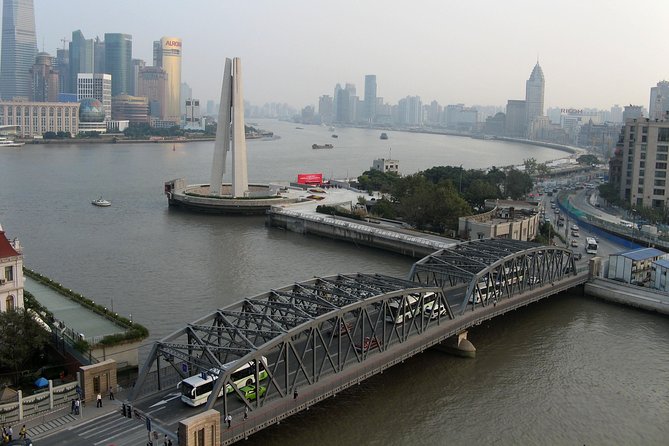
The tour ends with Waibaidu Bridge, also known as the first all-steel bridge and the only surviving example of a camelback truss bridge in China. The present bridge opened on 20 January 1908, which makes it a concrete marker of early modernization.
Bridges can be boring if you treat them like background. This one is different because the engineering is the story. The camelback truss shape is recognizable when you know what you are looking for, and the fact that it is still here makes it feel like a survivor from an earlier industrial era.
This stop is a great closer because it returns you to something visual and walkable. Even if you only get a short visit, it is the kind of place where you can take a few minutes to look at the structure rather than just the view.
Lunch break: authentic dumplings included
A big part of the value is that lunch is included: authentic dumpling lunch. In a packed day, this matters. You do not have to hunt for a meal, and you can plan around the schedule instead of letting hunger decide your route.
I recommend using this meal as your reset. Step away from history for a bit, eat something local, and then come back ready to absorb the political and architectural details again.
Price and value: what $175 buys you in a full day
The tour is priced at $175 per person and is usually booked about 32 days in advance. For a full day in Shanghai, I think the price makes sense if you value guided context and transportation over sorting everything yourself.
Here is what you are getting that drives value:
- Air-conditioned vehicle for the full day.
- Pickup offered, which saves time and mental load.
- Lunch included, not a vague snack or optional add-on.
- All fees and taxes covered.
- Several admissions are either free or explicitly included, like the Ancient City Wall and the Second National Congress site.
So you are paying primarily for the guide time and the coordination. If you were to DIY it, you would still spend money on transport and admissions, and you would lose the connective tissue that makes the day feel like one story.
The private-group setup can also be a quiet plus. You get the same schedule, but with less crowd pressure.
The guide matters: look for a team like Peggy
Two details from guide feedback stand out in how this tour can feel day-to-day. One guide, Peggy, is described as easy to get along with, speaking amazing English, taking great photos, and helping plan a unique trip around the city.
That matters because you will be visiting places where the context can make or break your experience. If your guide can explain what you are looking at, you will leave with a clearer mental map. If your guide can help with photos, you will actually get the shots you came for without awkward timing.
So when you book, look for that kind of support. If your assignment includes someone like Peggy, you are likely to have a smoother, more fun day.
Who should book this tour
This fits best if you want:
- Architecture and atmosphere in the French Concession area, starting with Moller Residence.
- History that feels grounded, including Zhou Enlai’s home and the Communist Party congress site.
- A tour that mixes the political and the physical, ending with an engineering landmark at Waibaidu Bridge.
- A guided day with lunch included and admissions mostly handled.
It is also a good option if you like photography and want help getting good angles and pacing.
If you want only cheerful, low-stakes sightseeing, the slaughterhouse-to-shops stop may not be your favorite part. But if you can handle that one thread, the overall storyline is strong.
Should you book? A practical decision guide
I would book this tour if you want a structured day that connects Shanghai’s past to what you see on the street today. The blend of free and included admissions, the authentic dumpling lunch, and the covered transport make it a solid value for a single day.
I would pause if you are the kind of traveler who needs long time at each stop to really linger. With an 8-hour day and one 30-minute city wall visit, you will likely feel the pace. This is more highlights with context than slow museum-style wandering.
FAQ
How long is the Shanghai Uncommon Historic Sites Tour?
It runs for about 8 hours.
What time does the tour start?
The start time is 9:00 am.
Is hotel pickup available?
Pickup is offered, and the meeting is arranged for your group.
Is lunch included?
Yes. Lunch is included as an authentic dumpling lunch.
Are admission tickets included?
Some admissions are free, and others are included, such as the Shanghai Ancient City Wall and the Site of the Second National Congress of the Communist Party of China. The tour price also covers all fees and taxes.
What is the cancellation policy?
You can cancel for free up to 24 hours in advance for a full refund. If you cancel less than 24 hours before the start time, the amount paid is not refunded.
Recently added around Shanghai
- Zhujiajiao with Private Customized Shanghai City Highlights★ 5.0 · 14 reviews
- Zhujiajiao & Shanghai:Private Day Tour Water Town to Skyline★ 5.0 · 12 reviews
- Zhujiajiao Water Town Private Tour with Night River Cruise★ 5.0 · 9 reviews
- Zhujiajiao Water Village: Private Tour from Shanghai★ 4.9 · 43 reviews
- Zhujiajiao & Shanghai:Small Group Tour Water Town to Skyline★ 5.0 · 4 reviews
- Yu Garden Shanghai Entry Tickets Booking And Trip★ 3.6 · 9 reviews
- Shanghai: Xintiandi, CCP Museum and French Concession Tour★ 5.0 · 9 reviews
- Water Town Zhujiajiao Shanghai: Boat Ride,Sights,Bites&Sips★ 5.0 · 7 reviews
Historical Tours, compared.
Beijing Historical Tour II including Summer Palace, Lama Temple & Panda Garden
Read our review →
Beijing Historical Tour I – Forbidden City, Tiananmen Square & Temple of Heaven
Read our review →
Tour of Jewish Shanghai led by a Jewish History Expert
Read our review →
Beijing Historic City Guided Walking Tour + Calligraphy Creation
Read our review →
All inclusive Two-Day Xi’an private Heritage Tour
Read our review →
Shenzhen History , Culture & Scenic + (Drone Delivery) tour
Read our review →
Xi’an Full Day Sightseeing Tour – Shaanxi History Museum, Big Wild Goose Pagoda, Ancient City Wall
Read our review →
Private Historical Tour: Guangzhou City Sightseeing Including Lunch
Read our review →Browse the lists this tour appears in